Ling - Language Learning
- 4.6
- Rating
- 1.00M
- Installs
- Free
- Price

 Analysis by App-foxy
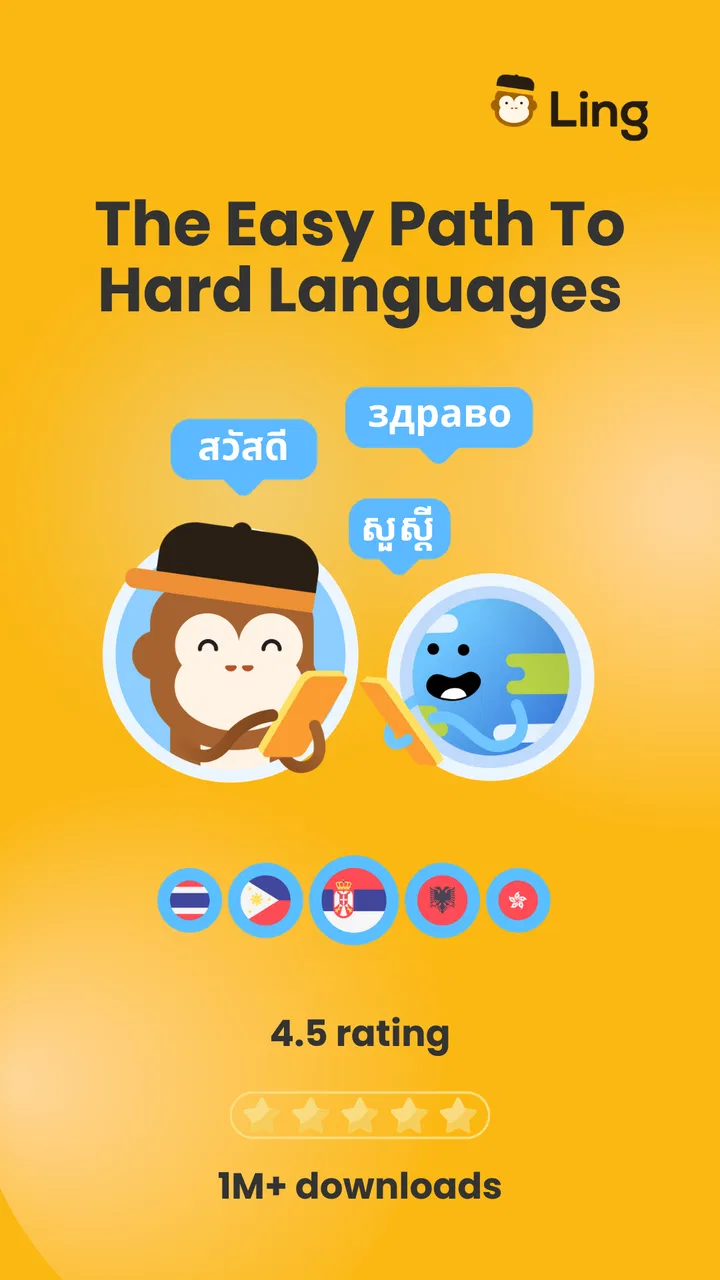
Learning a language on a phone sounds simple until the routine becomes repetitive, the explanations feel too shallow, or the app focuses on a language you do not actually want to study. Ling takes a broader approach. It is an education app from Ling Learn Languages that brings lessons for more than seventy languages, including Thai, English, Farsi, Serbian, and Urdu. That range is its clearest identity: it is not only aimed at the most common European languages.
I spent time with it as a practical study companion rather than treating it like a complete replacement for a teacher. My impression is positive, especially for beginners and for learners who want an accessible way into a less commonly supported language. The app is free to start, rated for Everyone, and its current version is 8.3.1. It has reached over a million installs, with an average rating of 4.5 from roughly thirty-one thousand ratings, so it has clearly found an audience beyond casual curiosity.
That popularity should not be mistaken for perfection. Ling works best when you use it for regular contact, vocabulary building, pronunciation practice, and basic sentence familiarity. It is less convincing as the only tool for advanced conversation, nuanced writing, or professional fluency. The difference matters because the app can make early progress feel pleasantly manageable while still leaving important parts of real communication to other resources.
You May Also Like

 Blood Strike: 2.5 Anniversary
Blood Strike’s Loadouts Turn Every Drop Into a Tactical Gamble
A close look at Blood Strike’s custom loadouts: how fast access to signature weapons reshapes its battle royale rhythm, rewards preparation, and narrows the gap between fights.

 Pandora - Music & Podcasts
Pandora’s Music Is Easy to Start, but Harder to Recover
Pandora’s strength is its low-effort path from a seed to a station. Its weak spot is how much confidence it asks you to place in connection, setup, and quiet recovery.

 8 Ball Pool
 Is Built on Rivalries, Rematches, and Routine
A close look at the rivalries, rematches, shared routines, and unanswered safety questions that turn a quick pool match into a persistent mobile community.

 Samsung Music
’s Quiet Strength Is Playing What You Already Own
Its reach comes less from spectacle than from dependable access to a personal library. That simplicity is both the app’s strongest retention engine and its ceiling.

 AccuWeather: Weather Radar
AccuWeather Review: A Quick, Clear Forecast for Everyday Decisions
For everyday plans, the best forecast is the one you can understand quickly. AccuWeather makes rain timing, radar, and local conditions easy to act on, with a few trade-offs.

 Hill Climb Racing
Why Hill Climb Racing Still Turns Crashes Into One More Run
A tiny car, a bumpy hill and one more upgrade: Hill Climb Racing keeps resurfacing because its simple chaos makes every near-miss feel personal.
More From Our News Desk



How Ling feels in everyday use
I find Ling most useful when a few people in a household take turns studying on a shared device, with each learner choosing a language or lesson that matches their own goal. That arrangement can make short practice sessions easy to fit into daily life, but I would keep a simple personal note of what each person has covered so one learner’s progress is not mistaken for another’s. The section below looks at how the app’s everyday rhythm supports that kind of use.
A broad language choice is the main reason to try it
The first decision with Ling is unusually important: choosing a language that many mainstream alternatives may not handle well. If you want to study Thai, Farsi, Serbian, or Urdu, the app’s large language selection immediately makes it more relevant than a typical beginner platform built around only the biggest global languages. It also includes English, so it can serve both learners of widely spoken languages and people looking for a more specialized option.
I like this breadth because it changes the starting question from “Which popular course should I use?” to “Does this app support the language I genuinely need?” That is a more useful test. A learner preparing for travel, reconnecting with family, or simply exploring a language with a different script can begin without first assembling several unrelated tools.
The trade-off is that a large catalog does not automatically mean every language has identical depth or polish. I would approach Ling as a strong entry point across its supported languages, not as proof that every course will match the needs of a long-term specialist. The safest expectation is a structured foundation, with additional listening, reading, and speaking practice added as your ability grows.
The lesson rhythm favors short, repeatable sessions
Ling is most useful when it becomes part of a small daily habit. I found the format easier to fit around ordinary interruptions than a long sit-down course. A few minutes while waiting for an appointment, during a commute, or after dinner can be enough to maintain contact with the language. That matters more than an ambitious schedule that lasts only a few days.
A realistic routine is to study one lesson when your attention is fresh, then return later to review the words or patterns that caused hesitation. I would not rush through several new sections just because the app makes progress feel easy. The better method is to pause whenever a phrase seems familiar but cannot be produced without help. Recognition is not the same as recall, and that gap becomes obvious when you try to speak.
One useful habit is to say answers aloud even when the exercise does not force you to. This turns a quiet tapping session into a small pronunciation check. It also exposes a common weakness early: knowing the visual shape of a word while still struggling to retrieve its sound. Ling can support that first step, but your own voice has to be part of the practice.
What the app is good at teaching first
For a new learner, the strongest value is the gradual accumulation of useful building blocks. Basic vocabulary becomes more manageable when it appears in a guided sequence instead of as an unorganized word list. The app gives you a place to begin, a visible path to follow, and a reason to return the next day.
I would especially recommend it to someone who feels intimidated by a new writing system or unfamiliar sentence patterns. Starting with a phone-based lesson can feel less demanding than opening a full textbook. That lower barrier is not trivial. Many people do not fail because they lack interest; they fail because the first study session feels too complicated to begin.
Parents and younger learners may also appreciate the Everyone content rating, although the app is not a substitute for choosing material appropriate to a particular child’s attention span. Adults can use the same friendly entry point for travel preparation or family communication. The best results come when the learner has a specific reason to use the language, since motivation supplies the context that short lessons cannot provide by themselves.
Where it fits beside familiar alternatives
Compared with a traditional textbook, Ling is more convenient and less intimidating. A book can offer deeper explanations and a clearer reference system, but it is easy to leave on a shelf. The app is better at prompting frequent contact. Compared with private tutoring, it is far cheaper to begin and easier to use at any hour, but it cannot respond to your personal mistakes or hold a genuinely adaptive conversation.
It also occupies a different space from flashcard-only tools. Flashcards are excellent for deliberate memorization and can be more flexible when you want to control a review list. Ling gives more structure and a sense of progression, which is helpful when you do not yet know what to study next. I would use the app for guided lessons and a separate notebook or flashcard system for words that repeatedly disappear from memory.
For pronunciation and real listening, authentic media eventually becomes necessary. A learner who relies only on short app exercises may understand lesson language but struggle with natural speed, reduced sounds, interruptions, or regional variation. Ling is a useful first layer, not the whole listening environment.
What the current version means for learners
When several learners share an interest in Ling, the practical question is how to coordinate without assuming the app will manage household routines for you. I would agree on who uses the device and when, and have each person keep track of their own study notes; that also helps adults guide younger learners without confusing an Everyone rating with a guarantee that every learning experience suits every age. The next section considers what version 8.3.1 offers learners in that context.
The product has clearly moved beyond a narrow beginner experiment
The current version, 8.3.1, shows that Ling is an established product rather than a newly assembled learning prototype. Its release history reaches back to November 25, 2018, and the app now has a substantial user base. I would interpret that evolution as evidence of continued maintenance and a mature direction centered on multilingual learning.
Still, a version number alone does not tell me that every part of the experience has recently changed. I prefer to separate what is visible now from what I might hope to see next. What is clear is the present combination of broad language coverage, a free entry point, and a learning format designed for mobile use. What remains a personal expectation is that future updates will keep improving depth, balance, and advanced practice across the catalog.
For an existing user, the practical lesson is not to abandon a working routine simply because the version has changed. Update when the platform offers a newer build through your normal app store, but judge it by whether lessons remain comfortable to navigate and whether your chosen language still supports your goals. Version labels are useful for identifying the current build; they are not a measure of your actual progress.
Free access lowers the risk, but purchases deserve attention
Ling is free to download and use as an entry point, which makes trying it less risky than committing immediately to a paid course. At the same time, in-app purchases range from $0.99 to $349.99 per item. That is a wide span, so I would inspect the purchase screen carefully before confirming anything and decide in advance how much the app is worth to your study plan.
My advice is to use the free experience long enough to answer practical questions: Does the selected language feel well suited to you? Do you enjoy the lesson rhythm? Can you imagine returning after the novelty fades? Only then should you consider paying for expanded access or other optional content. A high-priced option is not automatically bad, but it should be judged against your actual study frequency rather than enthusiasm on the first day.
This is also where Ling differs from a book purchase. A book usually gives you a fixed resource after one transaction, while an app may present several optional purchasing paths. That flexibility can be convenient, but it requires more attention from the user. I would avoid buying simply to remove the feeling that progress must continue immediately.
How existing learners can get more from it
If you already use Ling, the most effective improvement may be changing how you review rather than searching for a new feature. Keep a short list of words you repeatedly miss, but organize it by situation instead of alphabetically: greetings, transport, food, family, or work. Then revisit those words before starting a new lesson. This creates a bridge between the app’s sequence and your own real-life needs.
Another useful workflow is to pair each completed lesson with one tiny output task. Write two original sentences, record yourself saying a phrase, or describe something around you using the new vocabulary. The point is not to produce polished language. It is to move from recognition to retrieval, which is where many app learners discover that a completed exercise has not yet become usable knowledge.
I would also avoid treating every correct answer as equally secure. If you guessed correctly, mark it mentally as uncertain and return to it later. If you answered quickly and could explain why the sentence worked, it is probably stronger. This simple distinction makes a short session more honest and prevents the progress display from becoming the only measure of learning.
Remaining gaps that matter after the beginner stage
Ling’s biggest limitation is the natural limit of a guided mobile course: it can introduce language patterns, but it cannot fully recreate a conversation with a patient human who understands what you meant and corrects the details. Learners aiming for confident speaking should add conversation practice, even if that begins with a tutor, language exchange, or carefully prepared self-recordings.
Advanced learners may also want more control over explanations. Beginners often benefit from a clear path, while experienced students may prefer to jump directly to a grammar point, compare registers, or examine why two similar expressions are not interchangeable. If your main goal is formal writing, academic reading, or professional terminology, a reference grammar and authentic specialist material will eventually become more valuable than another sequence of introductory exercises.
There is a motivational limitation as well. A friendly app can encourage consistency, but it cannot create a meaningful reason to continue when progress slows. If you dislike repetition or want instant conversational confidence, Ling may feel too gentle. That is not a flaw for every learner; it simply means the app is better suited to steady foundation-building than to dramatic overnight transformation.
Who should choose it and who should look elsewhere
I would recommend Ling to beginners, travelers, heritage learners, and curious students who need a welcoming first structure. It is especially appealing when the target language is one of the less commonly supported choices in mainstream learning apps. The free starting point also makes it sensible for anyone who wants to test a routine before spending money.
I would be more cautious if you already speak at an advanced level, need exam-specific preparation, or require detailed professional language. In those cases, a tutor, a specialized course, or authentic material may be the better primary resource. You could still use Ling for warm-up practice, but I would not make it the center of an advanced study plan.
It may also be the wrong choice for someone who wants a completely offline, book-like reference or who dislikes app-based purchasing decisions. A physical course can be calmer and more comprehensive for certain learners. Likewise, someone whose priority is spontaneous conversation should place speaking with another person near the beginning, not wait until an app sequence feels complete.
What I would watch in future development
Because Ling supports such a wide range of languages, I would pay attention to how evenly its learning experience develops across that range. Broader availability is valuable, but depth matters just as much. Future progress would be most meaningful if learners could move smoothly from introductory vocabulary into richer listening, flexible sentence production, and situations that reflect how people actually communicate.
I would also watch how the app balances simplicity with control. Its approachable design is part of its appeal, yet experienced learners eventually need better ways to revisit weak areas, understand recurring errors, and choose material based on personal goals. The ideal direction would preserve the easy first step without making the later stages feel shallow.
For now, my recommendation is straightforward: try the free version, select one language with a real purpose behind it, and give yourself a modest routine rather than an unrealistic challenge. Use the lessons as a foundation, speak aloud, keep a personal review list, and add human conversation or authentic media when the basics begin to settle. Ling is strongest as a consistent starting point, not as a complete promise of fluency.
After using it in that role, I can see why Language Learning - Ling has earned a 4.5 average from around thirty-one thousand ratings and more than a million installs. It makes beginning less intimidating and gives learners access to an unusually broad set of languages. Its weaknesses become clearer at higher levels, and optional purchases call for thoughtful decisions, but the core experience is useful when approached with realistic expectations. If you want a friendly mobile companion for building a first foundation, I would gladly suggest giving it a try.
FAQs for Ling - Language Learning
01What is Language Learning - Ling, and how does it work?
Language Learning - Ling is a mobile app designed to help users learn new languages through interactive lessons and engaging exercises. It uses a combination of gamified challenges, quizzes, and conversational dialogues to enhance learning. The app supports multiple languages and adapts to your learning pace, making it suitable for beginners and advanced learners alike.
02Is Language Learning - Ling free to use?
Language Learning - Ling offers a free version with limited access to its features. However, to unlock all lessons, ad-free usage, and additional resources, users can subscribe to a premium plan. The pricing details can be found within the app, and there are often promotional offers available for new users.
03What languages can I learn with the Ling app?
The Ling app supports a wide range of languages, including popular ones like Spanish, French, German, and Mandarin, as well as lesser-known languages such as Thai, Vietnamese, and Serbian. The app continually updates its language offerings, so it's best to check the app store listing for the latest options.
04How effective is the Ling app for language learning?
Ling is designed with a comprehensive curriculum that covers vocabulary, grammar, and conversation skills. Users often find the mix of games and practical exercises effective in retaining information. Additionally, the app's adaptive learning system personalizes the experience to match the user's progress and needs, enhancing overall effectiveness.
05Can I use Language Learning - Ling offline?
Yes, Language Learning - Ling offers offline access for users who subscribe to certain premium plans. This feature allows you to download lessons and access them without an internet connection, making it convenient for learning on the go or in areas with limited connectivity.
Pros
- User-friendly interface for easy navigation.
- Wide variety of languages to choose from.
- Interactive exercises enhance learning.
- Progress tracking motivates continued use.
- Offline mode available for lessons.
Cons
- Limited free content without subscription.
- Occasional app crashes reported by users.
- Pronunciation tools need improvement.
- Lacks support for less common languages.
- Some features are locked behind paywall.

Ling - Language Learning
Gallery